

The humble yucca plant sits in the corners of many corporate headquarters. Most of the time it is unremarkable. But when conditions are right, it produces a sudden, striking bloom – a tall stem that rises above the plant before eventually withering back.
Corporate purpose may be behaving in much the same way.
For a decade or more, its trajectory appeared clear. Firms were moving, however unevenly, from a narrow focus on shareholder returns towards a broader conception of their role in society. Environmental commitments multiplied. Diversity targets were published. Chief executives spoke more readily about values as well as value.
That moment has not quite ended. But it has changed.
Today, many large companies no longer behave like confident standard-bearers of stakeholder capitalism. Nor have they reverted to the austere logic of shareholder primacy. Instead, they are doing something more ambiguous: proceeding cautiously, speaking more sparingly and committing more selectively. Purpose has not disappeared. For many, it has optically – not operationally – been paused.
This shift is often described as “greenhushing”: companies continuing sustainability work while talking about it less. The term has gained traction, but it misdiagnoses the problem.
What is happening is broader than climate, and deeper than communications. The same pattern is visible across diversity, social impact, technology and corporate positioning. Nor is it simply about avoiding criticism. It reflects a more fundamental reality: companies are increasingly reluctant to make commitments in a world where the ground is moving beneath them.
We call this “placeholder capitalism”.
The label is inelegant, but the behaviour is clear enough. Companies remain attentive to the expectations of employees, customers, regulators and wider society. Yet they are more wary of making bold, public commitments that might prove costly or constraining in a more volatile world. They are, in effect, buying time.
Three forces help explain why.
- The first is political risk. In the United States in particular, corporate engagement with ESG or diversity has become entangled in partisan conflict. What once signalled responsibility can now invite scrutiny. Even in less polarised markets, expectations are inconsistent: companies are expected to contribute to public goals, but not to overstep their remit.
- The second is technological uncertainty. Artificial intelligence promises to reshape industries, labour markets and business models. Yet few firms can say with confidence how. Investment is surging, but strategy is provisional. It is easier to extol AI’s potential than to define its consequences.
- The third is economic pressure. Higher interest rates, geopolitical instability and uncertain growth have returned boards to first principles: cash flow, margins and resilience. When capital is scarce, ambition gives way to discipline.
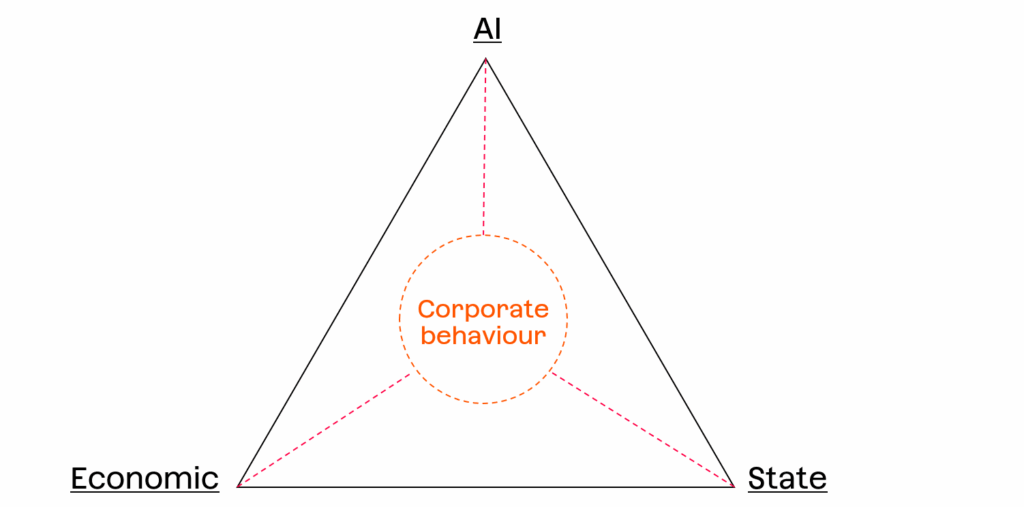
The result is a distinctive corporate posture. Firms soften their language without abandoning the underlying work. They maintain long-term goals while stretching timelines or lowering their profile. Corporate-affairs teams, once encouraged to lead public conversations, are increasingly tasked with managing exposure and polarised sentiment. Purpose is less often proclaimed and more often implied.
Consider two examples. Microsoft has been among the most vocal proponents of “responsible AI”. Yet even as it invests heavily, it has slowed elements of its infrastructure build-out and avoided definitive claims about the technology’s long-term impact on jobs or productivity. The ambition is clear; the end-state is not. By contrast, Novo Nordisk operates from a position of far greater clarity. Demand for its medicines is strong (albeit with Mounjaro stalling Ozempic’s meteoric rise), its business model is well understood, and it has been able to articulate a consistent position on access, affordability and health outcomes while investing heavily to expand supply.
In both cases, the pattern is revealing. Microsoft continues to signal direction, but with caution. Novo Nordisk aligns purpose closely with delivery, and expresses it with confidence. Neither has abandoned purpose. However, each reflects a different level of certainty about the future.
This has consequences. A quieter corporate voice leaves space for others – politicians, activists, competitors – to shape expectations. Waiting may preserve flexibility, but it can also erode influence. Legitimacy, once ceded, can be difficult to reclaim.
The task, then, is neither to revive the expansive rhetoric of the recent past, nor retreat into shareholder primacy. It is to build reputation in a world where commitment must coexist with uncertainty.
How can a business develop this approach? Three principles are worthy of consideration.
- First, anchor purpose in what the business demonstrably does, not what it says. In an era of scepticism, credibility lies in your operations.
- Second, favour proof over promise. Incremental, verifiable progress carries more weight than distant ambition.
- Third, preserve flexibility without disappearing. Strategic caution doesn’t need to entail silence; companies can shape debates without overcommitting to positions that may not hold. Be guided by long-term values and what is commercially and culturally important to your core business.
By definition, placeholder capitalism is a temporary phase. But for now it captures something real: a world in which companies are expected to lead, yet are no longer certain where leadership lies.
Like the yucca, purpose has not vanished. It is waiting for the right conditions to bloom again, and when it does, it is likely to look different from before.
Read more from Headland: Insights & News